Peat as an Adsorbent for Water Purification in Developing Countries

Phase 1: Batch Tests
Analysis with sampling per 24 hours

Figure 5: Change in percentage of metal ions removed with daily sampling
Figure 5 shows the change in the percentage of metal ions removed until the 96 hour mark. More than 90% of both heavy metal ions were adsorbed after 24 hours. The line graph also shows that the percentage of zinc ions adsorbed is slightly higher than that of lead(II) ions. A Kruskal-Wallis statistical test is performed to determine whether there was a significant difference in in the median of the percentage of lead(II) and zinc ions adsorbed over the 4 days. The p-value obtained for Lead(II) was 0.324 while the p-value of Zinc is 0.503, showing that there is no significant difference in the percentage of metal ions adsorbed.
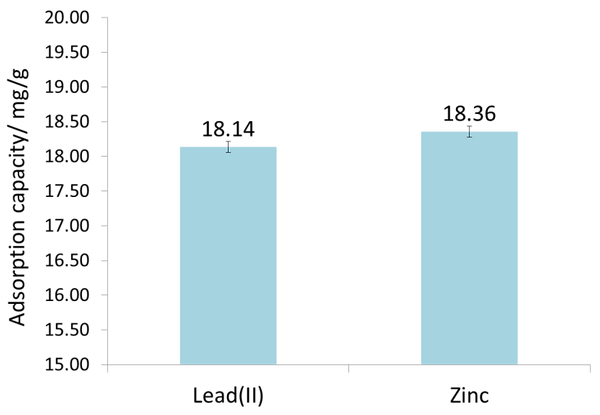
Figure 6: Adsorption capacity of lead (II) and zinc ions
Figure 6 shows the adsorption capacity of both metal ions plotted in a bar graph. The adsorption capacity of both metals is slightly higher than 18mg/g. The adsorption capacity of zinc ions is slightly higher than that of lead(II) ions. This correlates to the results in 3.2 which shows that a higher percentage of zinc ions were removed.

Figure 7: Percentage of metal ions removed every 5 minutes
Figure 7 shows that percentage of metal ions removed in the period of 30 minutes. From the graph, we can observe that most of the adsorption took place within the first 5 minutes. The adsorption of both metal ions occur at a very fast rate with the percentage of metal ions reaching more than 90% within the first 5 minutes. Although both metals show a relatively high rate of adsorption, we can observe that a longer period of time is required for the adsorption of zinc ions as compared to lead(II). This is evident at the 5 minute mark where 95.19% of zinc ions were adsorbed as compared to lead(II) (97.47%). However, the percentage of zinc ions adsorbed eventually became higher than that of lead(II) around the 14 minute mark. To summarise, we can observe that peat has a very fast rate of adsorption of both metal ions.